

Shipbuilding & Marine
Laser-based manufacturing technologies for large-scale structures and critical components
Core Processes for the Shipbuilding & Marine Industry
NKS Co., Ltd. delivers the core processes required for large vessel construction and operation — laser welding, surface treatment, and laser hardening.
Backed by collaborations with HD Korea Shipbuilding & Offshore Engineering, Hanwha Ocean, and Doosan Enerbility,
we apply proven laser processes directly to the shipbuilding and marine industry.
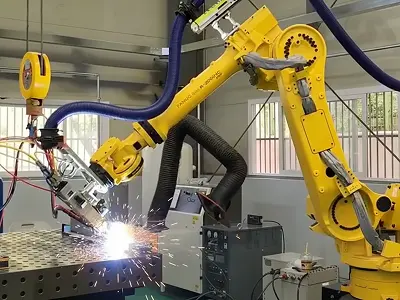
Hybrid Laser Welding for Thick Plates
For thick-plate welding in large vessel construction, we apply a hybrid welding process combining laser and arc. Deep penetration from high-density laser energy combined with the reinforcement effect of the arc process minimizes distortion and delivers consistent quality.
✓ Hybrid welding applicable to plates 30 mm and thicker
✓ High-precision welding technology that minimizes distortion
✓ Capability to build integrated laser-arc process lines
✓ Stable weld quality for repeatable production of large structures
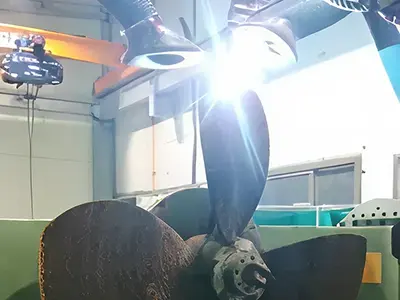
Propeller Blade Laser Cladding
Cladding processes applied to propeller blades — a critical component of vessel propulsion systems — restore function to worn or damaged areas and extend service life. Arc cladding enables localized reinforcement even on large, complex-shaped blades, delivering surface performance tailored to operating conditions.
✓ Cladding process design tailored to propulsion-system component characteristics
✓ Arc cladding process conditions optimized for large, curved blades
✓ Localized deposition with controlled reinforcement area and thickness
✓ Process application and quality verification based on real operating conditions
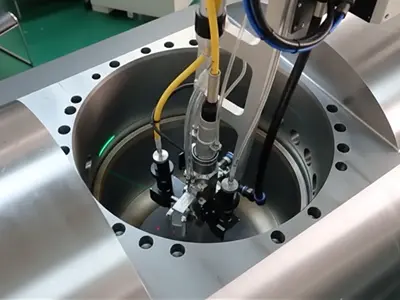
Engine Laser Hardening
We apply laser hardening to wear- and fatigue-prone areas of heavy-duty components such as crossheads in large marine engines, transforming the surface microstructure to increase hardness. Precise control of laser energy locally reinforces only the required areas, ensuring quality consistency and efficiency.
✓ Localized hardening for contact and sliding surfaces
✓ Consistent quality through precise control of laser parameters (power, scan pattern, etc.)
✓ Improved efficiency and cost through localized hardness enhancement
✓ Quality assurance via analysis-based reliability verification